
The walk to Estadio Ciudad de México – most fans know it as the Azteca – on Thursday did a pretty good job of laying out the two sides of Mexico as the Världscupen kicked off.
Flanked by volunteers and channeled towards the stadium by steel barriers, the lucky few to have scored a ticket to the tournament’s opener between Mexico and South Africa chanted, waved the country’s tricolor flag and cracked beers in the middle of the street. The path was flanked with performers, the sound of traditional banda music providing a festive atmosphere.
On the other side of the fence and a little way down the street, protesters clashed with police, as has often been the case in recent weeks. The crowd of protesters on Thursday was smaller, owing to the fact that Mexico’s president, Claudia Sheinbaum, very recently reached an agreement with the striking teachers who’ve made up much of that contingent. Some remained, lobbing debris at hundreds of riot police, who took shelter behind their shields.
There’s been talk in Mexico of the country’s place in the tournament being an afterthought. Most of the tournament’s matches will take place in the United States, which will also host the final. Canada and Mexico have been offered a token share, or as one fan outside the Azteca put it on Thursday, “un pedacito”. A tiny piece.
“The other times we had it,” the fan continued. “It was for the people. Not so this time.”
It was not this way in 1986, when Diego Maradona’s brilliance and deceit seared the tournament into the collective consciousness, nor in 1970, when Pelé’s triumph did the same. This World Cup has at times felt like a footnote in Mexico. Exorbitant ticket prices haven’t helped. On Thursday, a beer at the Azteca cost about 280 pesos, or $17. Tickets pushed well into the thousands.
None of this mattered much in the lead-up to the match, not to the lucky few. The gates to the stadium opened at 9am and fans were pouring through the turnstiles not long after. The Azteca, the closest thing North America has to a football cathedral, has undergone major renovations and it looked resplendent on Thursday, its somewhat charmless, concrete exterior gussied up for the occasion.
“I was surprised when we left where we’ve been based,” said midfielder Érik Lira after the match, which ended in a 2-0 victory for the hosts. “There were thousands of people waiting for us with words of encouragement along the route, when we were on the bus. It was beautiful, for me specifically because I grew up in this area. You’d see signs: ‘Mexico united,’ or ‘We love Mexico.’”
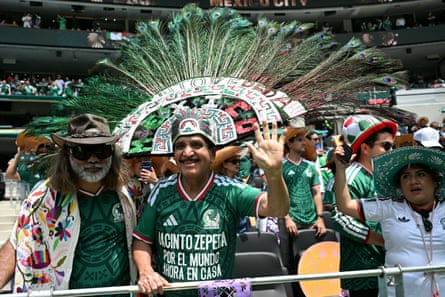
Inside, the scene was even more vibrant. Fifa did its best to turn the opener of this tournament into a soulless, masturbatory exercise full of enough pomp and circumstance to kill a football traditionalist. Yet the spectacle – the costumes, the smoke, the giant, exploding “Fifa” sign hanging over the pitch – somehow landed with the crowd. Tournament organizers did a good job of incorporating elements of Mexico’s wildly diverse culture into the presentation, and it went over well with the crowd.
Mexican fans, though, are notoriously tough on their national team – and they can be notoriously fickle. South Africa are among the most tepid sides at this World Cup. They never presented much of a challenge to Mexico, who easily dispatched them in a match that saw three red cards. What could have crushed the Mexicans was the weight of their own – and their fans’ – expectations, which could have quickly turned hostile had things gone sideways.
Mexico were spared the fans’ ire though. It took less than 10 minutes for Julián Quiñones to pounce on a defensive blunder and put the hosts ahead. The noise in the Azteca was thunderous. On the bench, Mexico head coach Javier Aguirre rose, his fists clenched in celebration, before being mobbed by his assistants and, eventually, his players. The noise and the feeling probably felt familiar: Aguirre was in midfield for Mexico’s opener in 1986 against Belgium, a 2-1 victory.
The crowd at the Azteca presented an insurmountable challenge for South Africa. The stadium is among the world’s most fearsome arenas, and Mexican fans are typically ruthless with rivals like the United States or, in the case of the World Cup, Argentina. South Africa were booed at every turn, including the warm-ups.
“The scene is brutal,” Aguirre told reporters after the match. “It makes your feet shake a little bit [if you’re the opponent]. You get on the bus to come here, the people are in the streets already. If you’re a player, you look around at that and you say, ‘Oof.’ You [get to the stadium] and look up and up and up and then you’re getting confused making basic passes.”
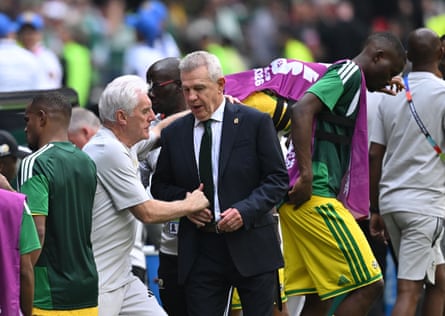
Aguirre’s side were not spared the boos. Up 2-0, Mexican fans began to whistle at their own team when they knocked the ball around in an attempt to waste time. It was an understandable approach tactically, but on a day like Thursday – with 80,824 rapturous fans celebrating not only Mexican football but the country itself – it simply would not do. Mexico never relented, threatening the South African goal until the final whistle.
“4-0, the game should’ve been,” Aguirre said, laughing. “The people had a right to boo.”
Instead, they broke into song at the final whistle, serenading the team, and each other, with a deafening rendition of Cielito Lindo. It was a beautiful scene. By the time fans started spilling out of the Azteca’s giant portals and into the surrounding streets, much of the strife between protesters and police had died down. It will surely return soon: Mexico’s social and economic problems will not be solved by football.
To those in the Azteca on Thursday, El Tri did at least provide a respite.